








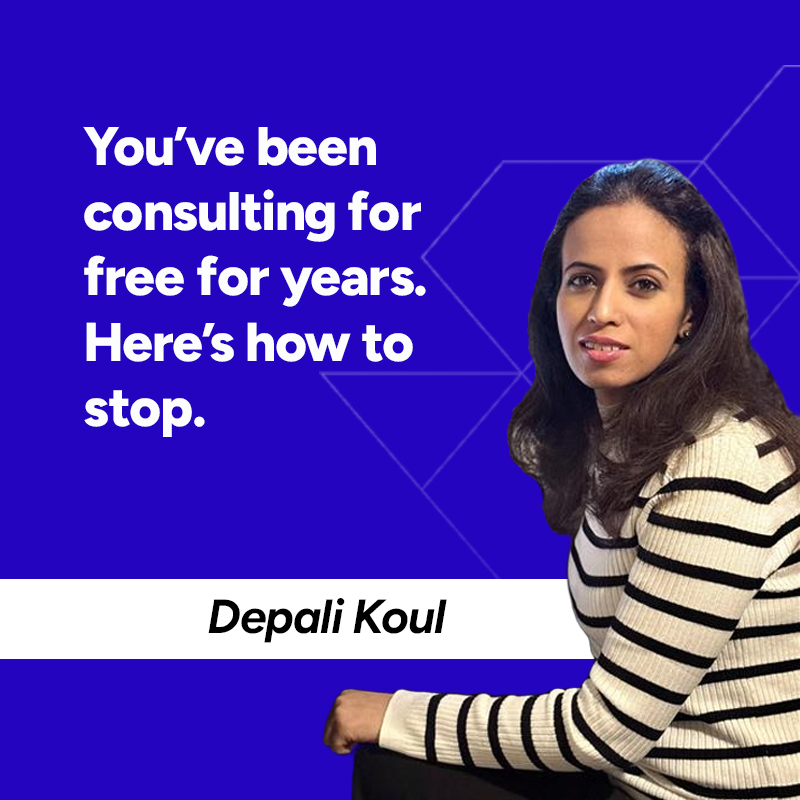
It starts with a WhatsApp message. It always does.
“Hey, you work in finance, right? My business partner and I are arguing about equity structure. Nothing formal, just your thoughts.”
You type back 400 words. You explain cap tables, vesting schedules and cliff periods. You answer follow-up questions for forty minutes. Then you put the phone down and go back to work. The job that actually pays you.
That conversation? A startup advisor charges £150 to £250 for exactly that. A verified consultant on Kyoho charges the same. You charged nothing. And you have been doing it for years.
To the person on the other end of your WhatsApp, what you just typed was worth hundreds of pounds. The only problem: they did not pay it, and you did not ask.
Free Advice Does Not Just Cost You. It Costs Them Too.
Here is the part nobody says out loud. When you give expert advice away for free, you devalue the advice itself. People treat free counsel the way they treat free samples. They take it, file it away and move on.
The friend who gives free legal advice gets ignored. The solicitor who charges £300 for the same advice gets a client who reads every word, implements every recommendation and calls back to say it worked. The price signals seriousness on both sides.
The other objection: “I do not want to charge my relationships.” Fair. Do not charge your friends. But the person who found you through a mutual acquaintance, slid into your LinkedIn DMs, or heard your name from someone who heard it from someone else? That is not a relationship. That is a client who deserves your full, structured, professional attention. Not a rushed WhatsApp reply between meetings.
Why do less qualified experts win better clients?
It comes down to three things that have nothing to do with what you know.
- Findability. Can they even locate you when they need you?
- Clarity. Do they immediately understand what you do?
- Trust signals. Do reviews and verified credentials back you up?
Most high-calibre professionals fail on all three. Not because they lack the substance, but because they have never had to make the substance visible. Their careers were built inside organisations where reputation moved internally. Clients came through colleagues. Referrals happened over lunch.
That infrastructure disappears when you go independent. And the professionals who thrived inside it often struggle the hardest outside it. Not because their expertise diminished, but because the systems that made them findable belonged to their employer, not them.
3 Signs you are already a consultant, just an unpaid one.
- People preface requests with “I know this is a lot to ask.” That qualifier is them acknowledging your expertise has value. They are pre-apologising for the imposition. That is a market signal.
- You have been referred to a stranger as “the person to ask.” The moment you become a word-of-mouth recommendation; you have a reputation. A reputation is a brand. A brand is a business. You are just not charging for it yet.
- You feel vaguely resentful after helping someone for free. That quiet frustration is not pettiness. It is your instinct telling you an exchange happened that was not equitable. Trust it. It is right.
The gap between an expert and a consultant is not knowledge. It is a booking link.
4 Steps from giving it away to getting paid
- Name the one thing people always ask you about. Not everything you know. One thing. The question you have answered fifty times. That specificity is what makes a service bookable and searchable.
- Define what a session with you actually looks like. “60-minute strategy call where we diagnose your pricing and leave with three changes to implement this week” is bookable. “I do marketing consulting” is not. Scope removes friction.
- Set a price that reflects the outcome, not the hour. A 45-minute call that saves someone £10,000 is not worth £45. Price the value. Start at a number that feels slightly uncomfortable. That is usually about right.
- Create a verified profile on Kyoho and tell three people. Not a mass announcement. Just three people who already know your work. Kyoho handles scheduling, payment and delivery. Your first booking almost always comes from the first three people you tell.
The consulting industry was designed to keep you out. That is changing.
For decades, consulting meant suits, slides and big-firm brand names. That mythology served the big firms. It convinced brilliant professionals they did not qualify.
That era is ending. The future of consulting is the chartered accountant with 12 years of SME experience. The marketing director who has launched 40 brands. The education advisor who knows every nuance of the UCAS process. Available, verified and bookable.
Kyoho operates across 30+ countries with verified consultants across 25+ categories. The infrastructure exists. The clients exist. The only missing piece is your decision to participate.
Your expertise has been working for free long enough.
Ready to change that? Start your Kyoho profile today at kyoho.io.